
When a bank reports a cash transactions, it does not necessarily submit the report that same day. Federal rules give financial institutions a specific amount of time to file a Currency Transaction Report (CTR) with the Financial Crimes Enforcement Network (FinCEN).
The general CTR filing deadline is 15 calendar days following the day the reportable transaction occurs. That means weekends count, and the deadline is not 15 business days.
I’m Leanthony Stephens, and in this guide, I’ll break down when the deadline starts, how to count the days, and what the rule means for banks and their clients.
Quick Answer
When must a CTR be filed? A financial institution generally must file a Currency Transaction Report within 15 calendar days following the day of the reportable transaction.
The bank is responsible for meeting this deadline. The customer does not normally file the CTR or calculate the bank’s filing deadline.
What is the CTR filing deadline?
Under federal regulation 31 CFR § 1010.306(a)(1), a financial institution must file a reportable Currency Transaction Report within 15 days following the day the transaction occurred.
In everyday terms, this means the bank has 15 calendar days after the transaction date to file the report with FinCEN. This is the general deadline for covered CTR filings.
The deadline is a requirement for the financial institution. It is not a deadline for the customer to complete paperwork or contact the IRS.
When does the 15-day countdown start?
The countdown starts the day after the reportable transaction occurs. The transaction date itself is not counted as day one.
For example, if a reportable transaction takes place on April 8, the first day of the filing period is April 9. The bank then counts 15 calendar days from that point.
This distinction matters because counting the transaction date as the first day would produce the wrong deadline.
How do you calculate the CTR filing deadline?
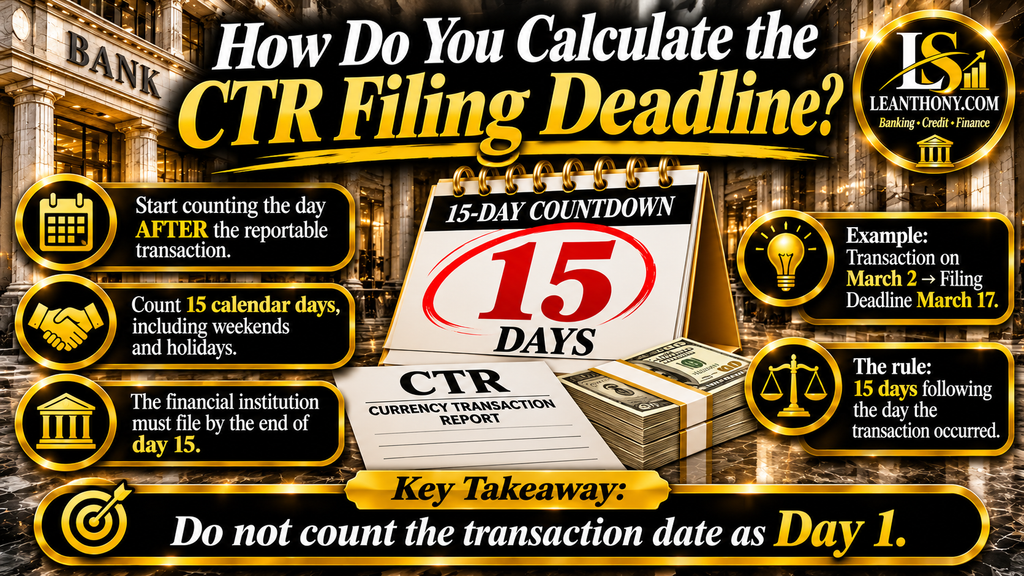
Here is a simple example of how the CTR filing deadline works.
Example: A reportable transaction takes place April 8, 2026.
| Date | Filing countdown |
| April 8 | Transaction date |
| April 9 | Day 1 |
| April 10 | Day 2 |
| April 15 | Day 7 |
| April 20 | Day 12 |
| April 23 | Day 15 — filing deadline |
In this example, the financial institution’s general filing deadline is April 23, 2026.
The important point is that the 15-day period begins after the transaction date. The bank must meet the deadline even if the customer has already left the branch or completed the transaction.
Does the deadline include weekends and holidays?
Yes. The CTR filing deadline is measured in calendar days, not business days.
That means Saturdays and Sundays are included when counting the 15 days. Do not automatically add extra days because a weekend falls within the filing period.
The regulation states the general 15-day period. Banks are responsible for managing their filing process so they meet that requirement.
Was the CTR deadline ever 25 days?
You may find older websites or documents that mention a 25-day CTR filing period. That can be confusing if you are trying to understand the current rule.
FinCEN explains that the 25-day period was a temporary arrangement for financial institutions adjusting their filing processes.
That temporary period ended on March 31, 2013.
As of April 1, 2013, the current general deadline has been 15 calendar days. The 25-day period should not be treated as the current filing rule as it is outdated by over 13 years to date.
What happens if a bank files a CTR late?
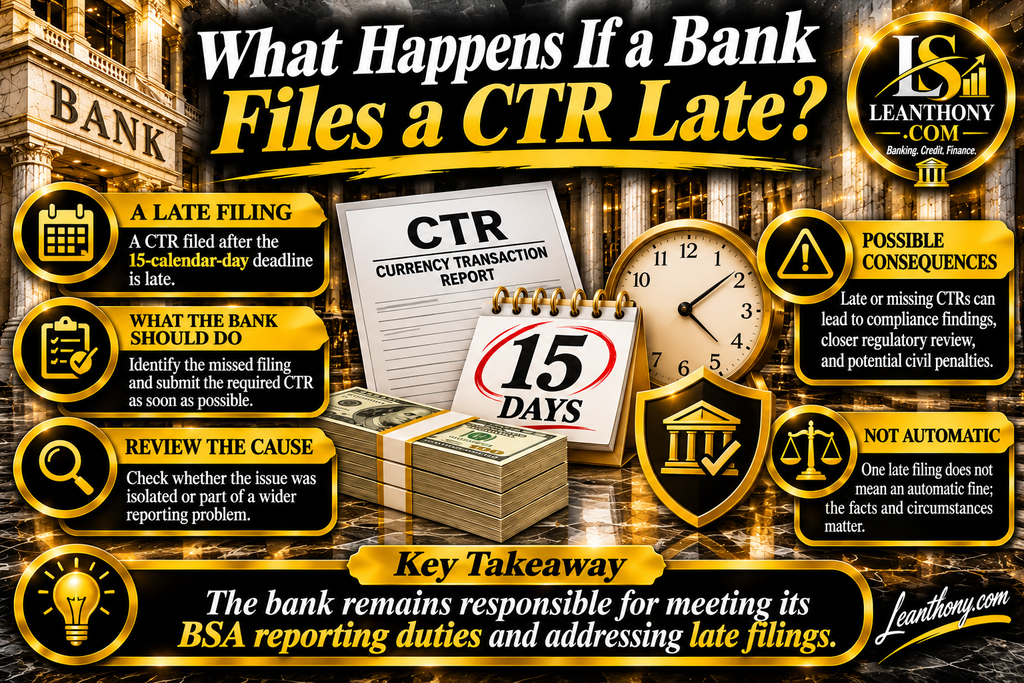
A bank that misses the required filing deadline has not met the reporting timeframe established by federal regulation. The filing obligation does not disappear simply because the deadline passed. A late filing may be identified when the institution’s reporting practices are reviewed by regulators or examiners.
The exact response depends on the circumstances. The important point is that the 15-day deadline is a compliance requirement, not an optional target.
Does the deadline affect the customer?
The CTR filing deadline is the responsibility of the bank or other reporting financial institution. A customer does not complete the official report, submit it to FinCEN, or control when the bank files it.
If a bank asks questions during a cash transaction, that is separate from the deadline for submitting the report. The bank may need to collect or verify information before completing its reporting responsibilities.
Final Thoughts
The CTR filing deadline is generally 15 calendar days following the day a reportable transaction takes place. The transaction date is not counted as day one, and weekends are included in the countdown.
Understanding this rule helps clear up confusion about when banks must report qualifying cash transactions. The responsibility belongs to the financial institution.