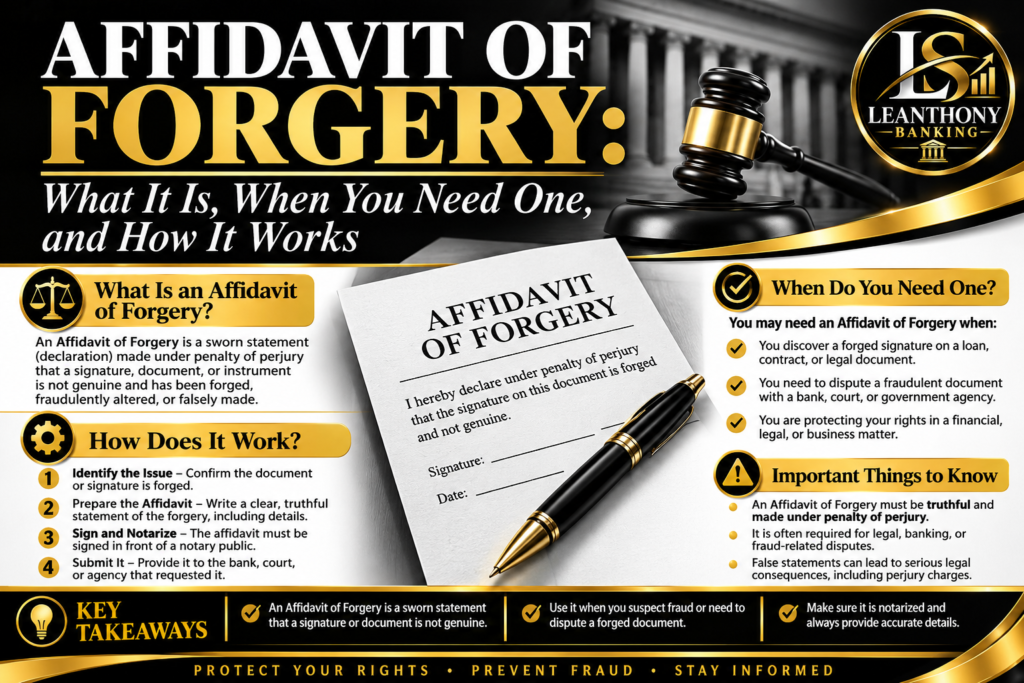
Discovering a check you never wrote or a signature you never authorized can be stressful. If your bank asks you to complete an affidavit of forgery, understanding the document can help you know what information to provide and what happens next.
At my time at Armed Forces Bank, I have done my fair share of affidavits of forgery forms; and I thought that if my clients have these concerns and questions, than it must be many more people who have the same questions without a way to have them answered.
So What’s The Quick Answer?
An affidavit of forgery is a formal written statement declaring that a check, signature, endorsement, or related financial document was forged or used without authorization. A bank may request it to document your claim and support its investigation.
Signing one does not prove forgery occurred or guarantee reimbursement. The financial institution must review the evidence and applicable requirements before deciding how to resolve the claim.
Affidavit of Forgery Explained
An affidavit of forgery is a formal written declaration in which someone states that a signature, endorsement, or financial instrument was used without their permission. In banking, it commonly supports a customer’s claim involving a forged check or unauthorized signature.
An affidavit is generally a statement made under oath or affirmation. Depending on the institution’s form, it may require notarization, but not every affidavit must be notarized.
Unlike a verbal complaint, the document creates a written record of what the customer is disputing. It does not independently establish that forgery occurred; the bank evaluates the statement alongside other evidence.
When Might a Bank Ask You to Complete an Affidavit of Forgery?
A bank or credit union may request an affidavit when a customer reports an unauthorized signature or suspected check fraud. Common examples include someone signing your name on the front of a check, stealing and cashing a check, or forging your endorsement on the back.
A bank may also investigate an altered check, where someone changes its amount or payee. The requirements that will have bank request you to complete a Affidavit of Forgery vary by transaction, financial institution, account agreement, and applicable law.
What Information Does an Affidavit of Forgery Usually Require?
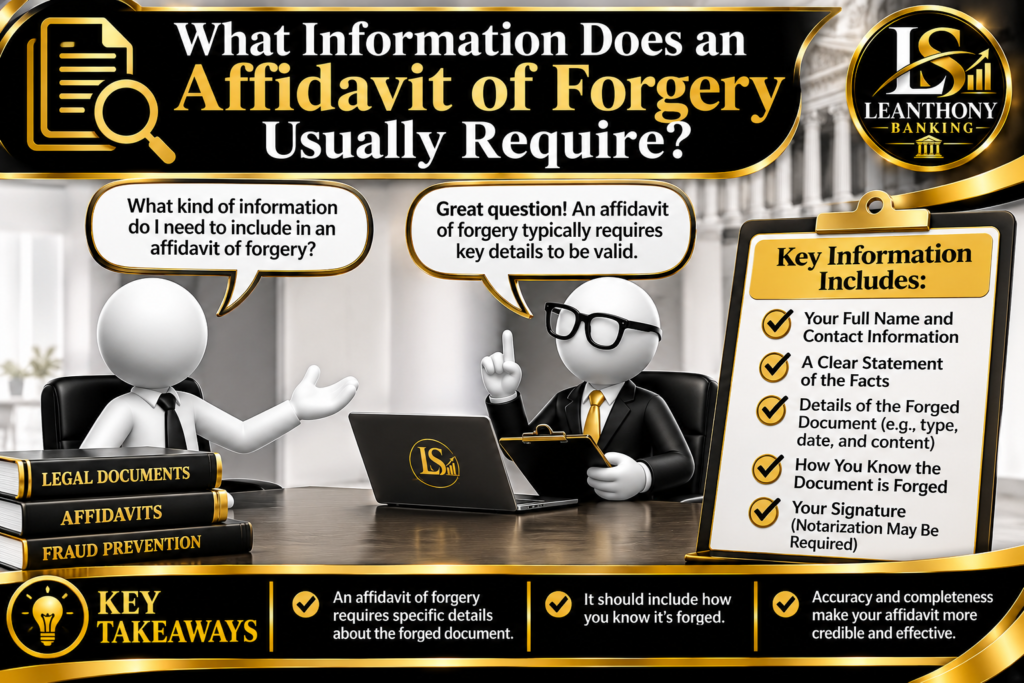
An Affidavit of Forgery form may include one or more of the items below:
- Your name and contact information.
- Relevant account information.
- Check number, date, amount, and payee.
- When you discovered the suspected forgery.
- An explanation of what happened.
- Whether you recognize or authorized the transaction.
- Your signature, date, and requested supporting documents.
Be accurate when completing the statement. Use the form provided by your bank rather than assuming a generic affidavit of forgery template will be accepted, and avoid sharing unnecessary sensitive information.
What Should You Do If You Suspect Check Forgery?
CONTACT YOUR BANK IMMEDIATLY!
Your bank is going to ask you to identify the disputed transaction. Ask the institution to investigate and explain whether it requires an affidavit or another form.
Request the front and back check images if available, keep copies of your documents, and record your communications. If checks were stolen, ask whether your account should be replaced or receive additional security measures; a police report may also be useful or requested.
What Happens After You Submit an Affidavit of Forgery?
After you submit your Affidavit of Forgery your bank will review your statement and examine check images, account activity, deposit records, and other transaction information.
Your financial institution may also request additional documentation or communicate with other financial institutions involved.
After evaluating the evidence, applicable law, and account terms, the institution communicates its decision. It may approve reimbursement, deny the claim, or request more information; there is no universal investigation timeline for every paper-check dispute.
Does an Affidavit of Forgery Need to Be Notarized?
Most institutions require a notarized affidavit of forgery, while others accept their own signed form without notarization. The requirements depend on the document and the bank’s procedures.
Follow the instructions given by your financial institution and the exact form you receive. If the instructions are unclear, ask the institution before signing or submitting it.
Can a Bank Deny a Forgery Claim?
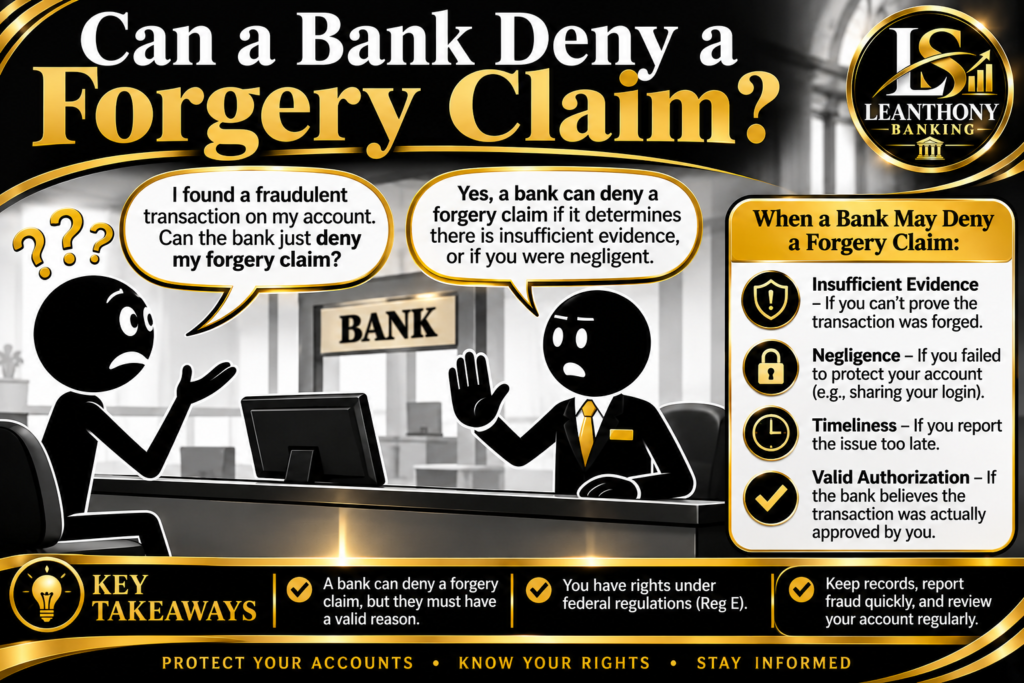
Yes.
Your bank may deny your claim if the evidence does not support the allegation or applicable legal rules affect responsibility. However, a processed check does not automatically mean the customer authorized it.
If your claim is denied, request a written explanation, ask about submitting additional evidence, and consider escalating through the bank’s complaint process or the appropriate regulator. The OCC handles complaints involving national banks and federal savings associations, however The OCC does not regulate every financial institution.
How Is an Affidavit of Forgery Different From Other Fraud Claims?
A forged signature, forged endorsement, and altered check are different problems. An unauthorized electronic transfer is different again and may be covered by federal protections under the Electronic Fund Transfer Act and Regulation E.
| Situation | What happened |
| Forged signature | Someone signed the account holder’s name without permission. |
| Forged endorsement | Someone signed the payee’s name on the back of a check. |
| Altered check | Someone changed the amount or payee. |
| Unauthorized electronic transfer | Money moved electronically without authorization. |
Do not assume check-forgery rules apply to electronic transactions. Covered electronic transfers have separate reporting and investigation requirements.
LeAnthony Stephens Daily Example:
Situation: A customer notices a $500 check on their statement that they never wrote. After obtaining the check image, they see a signature they did not authorize.
Solution: The customer contacts the bank, completes the requested affidavit of forgery, and provides the check details. The bank uses the statement and supporting records to investigate; the affidavit documents and the customer’s claims, the bank determine the a check was indeed forged and reimburse the customer.
Final Thoughts
An affidavit of forgery gives a bank a formal record of a customer’s allegation involving an unauthorized signature, check, or endorsement. It can support an investigation, but it does not guarantee that the disputed money will be returned.
If you are asked to complete one, read the instructions carefully, provide truthful information, and report suspected check fraud promptly.
I’m Leanthony Stephens, making banking, credit, and consumer finance easier to understand.
Have a great day and thanking you for reading.
Sources
- CFPB: Forged endorsement on a check
- CFPB: Unauthorized check written on an account
- OCC: Forged checks and customer negligence
- OCC: Check fraud guidance
- UCC § 3-406
- UCC § 4-406
- CFPB: Regulation E § 1005.11
Legal note: UCC provisions are adopted through state law and may vary. This article provides general educational information, not legal advice.
