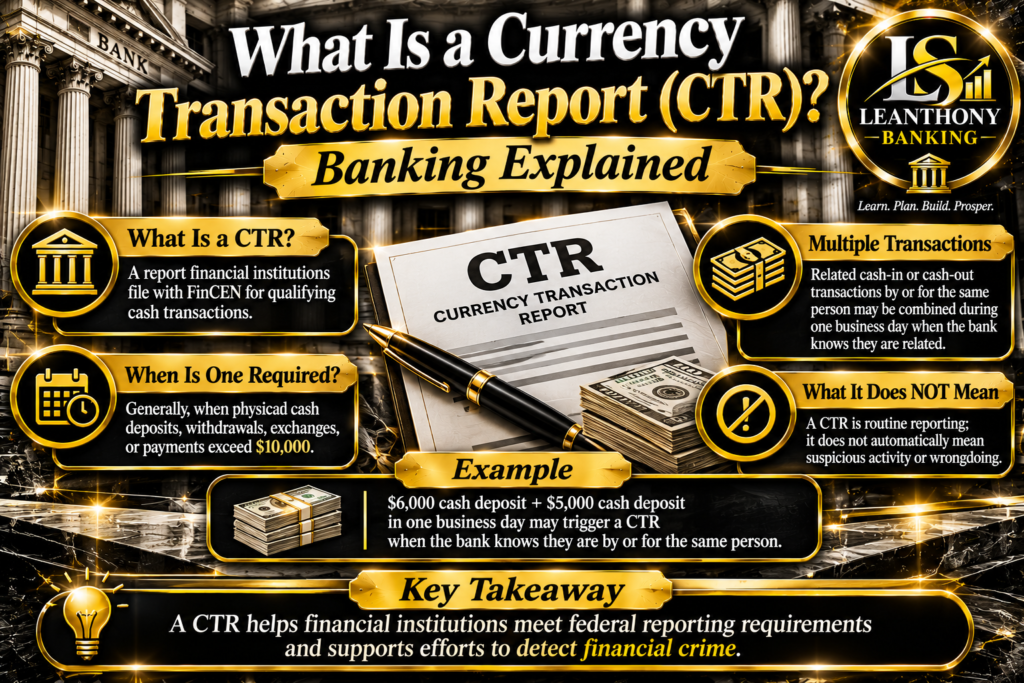
When you walking into a bank to deposit or withdraw a large amount of cash, you may be asked additional questions or asked to provide identification. Sometimes, the transaction may require a Currency Transaction Report (CTR).
If you have ever wondered what a currency transaction report is, you are not alone. In my banking experience, I have completed multiple CTRs for customers making large cash deposits and withdrawals. Some customers understand the process, while others are frustrated by the additional questions and waiting time.
I’m Leanthony Stephens, a personal banker for Armed Forces Bank and I want to explain CTR banking in plain English so you understand why banks collect this information and what it actually means for you.
Quick Answer: What Is a Currency Transaction Report?
A Currency Transaction Report (CTR) is a report that certain financial institutions must file with the Financial Crimes Enforcement Network (FinCEN) when qualifying cash transactions exceed $10,000 in one business day.
The report helps the government monitor large cash transactions under the Bank Secrecy Act (BSA). A CTR does not automatically mean a customer is suspected of a crime, owes taxes, or is in trouble.
What Is a CTR in Banking?
The CTR meaning in banking is straightforward: it is a required report documenting certain large cash transactions.
A currency transaction report is associated with the Bank Secrecy Act, a federal law designed to help prevent financial crimes such as money laundering.
Banks and other covered financial institutions use CTR filing to report qualifying physical-currency activity.
For example, a customer depositing $12,000 in cash or withdrawing $15,000 in cash will always trigger a CTR.
However, not every transaction over $10,000 qualifies.
The reporting requirement generally applies to physical currency, not simply any transaction involving a large dollar amount. Such as a check, ACH payment, or wire transfer.
Why Do Banks File Currency Transaction Reports?
Banks file currency transaction reports because federal regulations require them to monitor and report qualifying cash activity.
The currency transaction report requirements are part of the broader Bank Secrecy Act compliance framework. These requirements help authorities identify and analyze financial activity that may be relevant to financial investigations.
In my personal banking career, customers have asked “why I need so much information and why the process is taking so long”.
I always explain that collecting the information supports customer safety and the bank’s compliance responsibilities.The questions are not necessarily a sign that the customer has done anything wrong. Most clients are just in a rush or are simply just impatient.
However as bankers we have obligations to report, and follow the procedures established by our financial institutions.
What Is the $10,000 CTR Reporting Threshold?
Generally, a CTR is required when qualifying cash transactions total more than $10,000 during one business day. This means that exactly $10,000 does not meet the general threshold by itself.
The rules also account for multiple transactions. For example, if a customer makes two qualifying cash deposits of $6,000 each on the same business day, the bank may combine them when they are by or on the behalf of the same person.
Cash deposits and cash withdrawals are calculated together. A deposit and withdrawal are not simply offset against each other. So if you deposit $5,000, and then withdrawal $6,000, 9/10 you will be recieving a call from your bank to verifiy the reasoning for moving such a large amount of money.
These currency transaction report requirements are important because the total amount is not limited to one transaction at a time or even in a day. Many small transactions totalling 10,000 in a short amount of time can lead to a CTR.
What Information Does a Currency Transaction Report Form Collect?
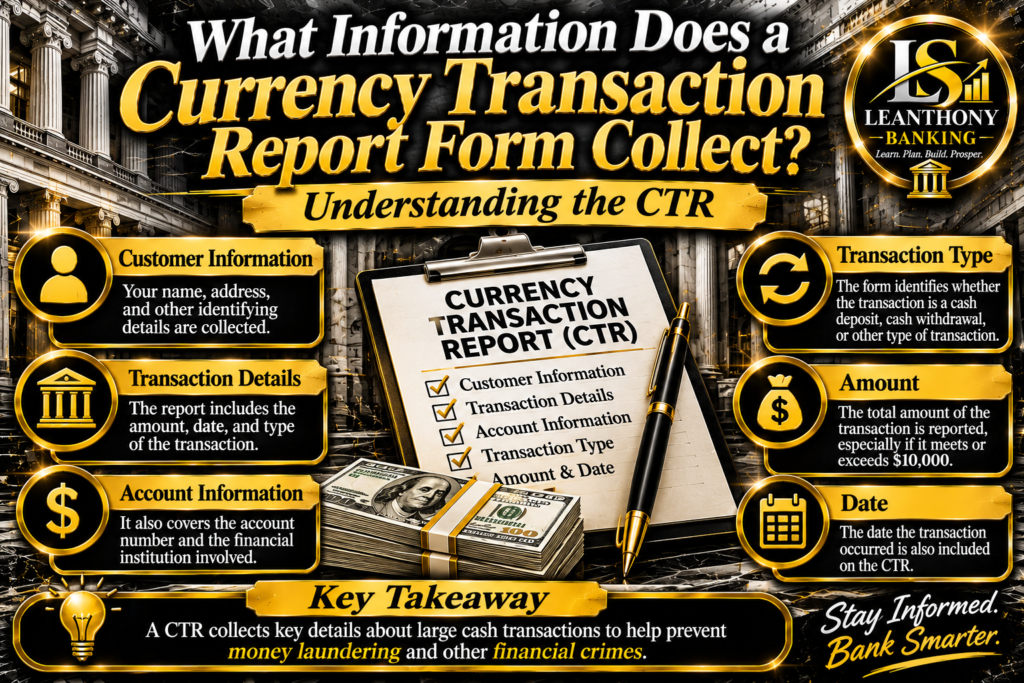
A currency transaction report form, officially known as FinCEN Form 112, collects information about the transaction and the people involved.
Depending on the circumstances, the bank may need information such as:
- Customer identification details
- Transaction date and amount
- Type of cash transaction
- Financial institution information
- Information about the person conducting the transaction
I have personally contacted customers to verify additional information about transactions. Just last Friday, I called a customer to confirm information regarding a transaction over a month ago.
So trust me compliuance is watching and for all my bankers out there they will ask.
Customers may misunderstand these requests and think they are in trouble. However, collecting accurate information is part of the bank’s reporting process. Just because a CTR or BSA is triggered does not mean that the customer is in trouble or have done something wrong in any regards. The currency transaction report form just helps document the transaction for compliance purposes.
So Does a CTR Mean You Are in Trouble?
No.
Receiving a CTR does not automatically mean you are suspected of wrongdoing.
During my banking career, I have completed CTRs for customers withdrawing $15,000 and depositing $12,000 in cash. Most customers understand the requirement, however some become frustrated with the questions being asked and the waiting time while we are completing the required paperwork.
To this I say, the clients have to be patient. Clients will then sometimes try to lessen the amount so that they will not trigger CTR however that is now structuring. Which is now a bigger reason to submit a CTR Form.
The biggest misconception I want readers to understand is that a CTR does not automatically affect your credit score, create a tax bill, or mean the IRS is coming after you.
You don’t know how many times I have had to clarify that.
A CTR is a compliance report, not a tax assessment.
However, CTR information is stored by FinCEN and can be accessed by authorized government agencies. I of course could not promise that a filing could never receive further attention.
Who Files a CTR and Where Does It Go?
The financial institution is responsible for filing the report with FinCEN. Customers do not personally submit a currency transaction report just because they make a qualifying cash deposit or withdrawal.
Generally, covered institutions must electronically file a completed CTR within 10 calendar days after the reportable transaction.
The CTR filing process is handled by the institution, although customers may be asked to provide identification or answer questions so the bank can complete the required information.
CTR vs. SAR: What Is the Difference?
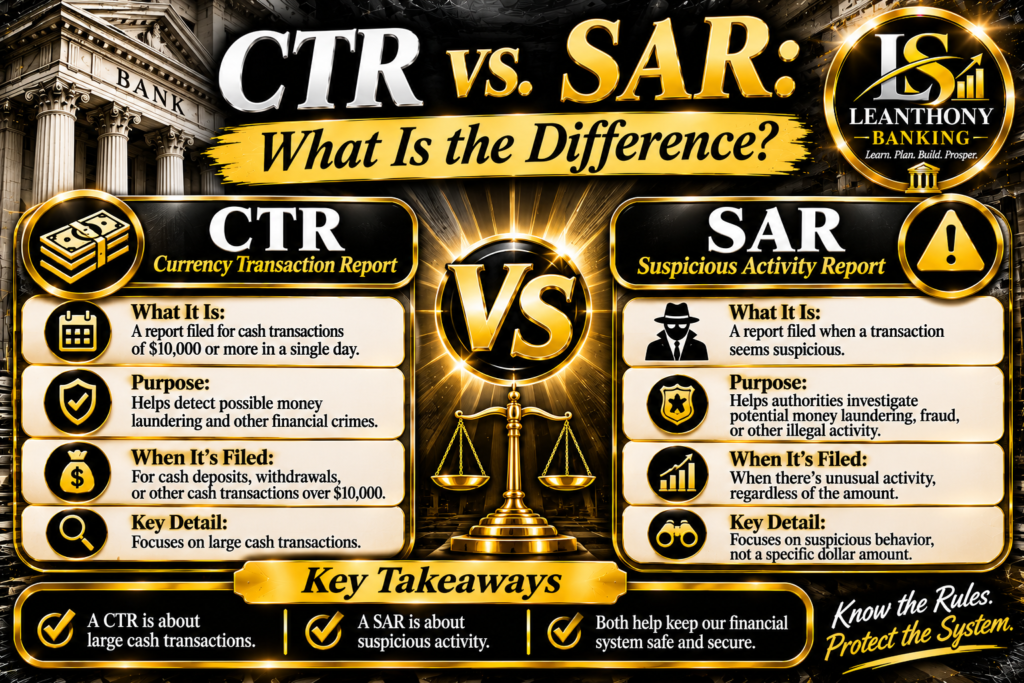
A CTR and a Suspicious Activity Report (SAR) are two different types of reports.
- A CTR is generally based on qualifying cash transactions exceeding the reporting threshold.
- A SAR is filed when a financial institution identifies activity that meets applicable suspicious-activity reporting criteria.
A CTR does not automatically mean a SAR has been filed. Likewise, a transaction below the CTR threshold can still raise concerns that require separate review under applicable reporting rules.
Understanding the difference helps explain why CTR banking procedures exist without assuming every large cash transaction is suspicious.
Frequently Asked Questions
Does a CTR affect my credit score?
No. A Currency Transaction Report is not a credit-reporting item and does not automatically lower your credit score.
Does the IRS receive every CTR?
CTR information is filed with FinCEN, not submitted as a tax return. Authorized government agencies, including IRS criminal investigators, may access CTR information under applicable rules. A CTR alone does not mean you owe taxes or are being investigated.
Do I have to file my own currency transaction report?
No. The covered financial institution is responsible for filing the CTR. You may need to provide identification and transaction information.
Can a bank file a CTR for a cash withdrawal?
Yes. Qualifying cash withdrawals can trigger the same general reporting requirement as qualifying cash deposits.
Is a currency transaction report the same as a suspicious activity report?
No. A CTR is generally triggered by qualifying cash activity above the reporting threshold. A SAR concerns activity that meets applicable suspicious-activity reporting criteria.
Final Thoughts
Understanding what a currency transaction report is can make a large cash transaction at your bank less confusing.
A CTR is a compliance requirement designed to document qualifying cash activity, not an accusation against a customer.
From my experience working in banking, I know that additional questions and waiting time can be frustrating. But understanding the reason behind the process can make the experience easier.
I’m Leanthony Stephens, and my goal through Leanthony.com is to help everyday consumers understand banking, credit, and consumer finance without unnecessary confusion.