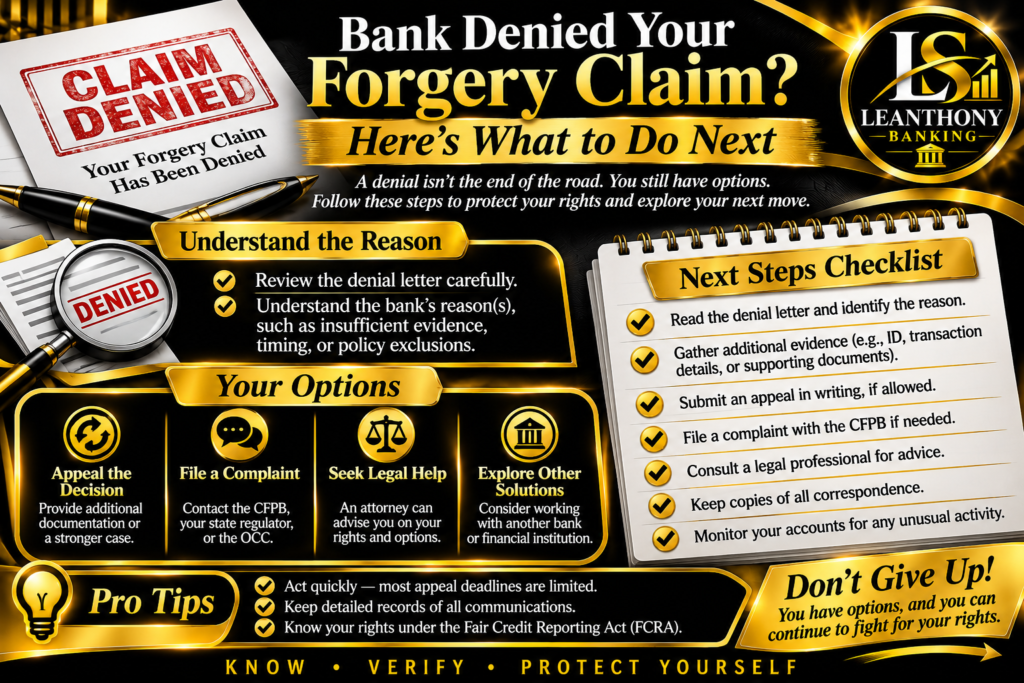
Imagine checking your bank statement and discovering a check you never signed was paid from your account. You report the suspected forgery, complete an Affidavit of Forgery, and provide the information your bank requests. Then you receive a notice saying your claim has been denied.
At that point, you probably want to know whether the bank can do that and what options you have left. I want to walk you through what a denial actually means, why it may have happened, and what I would look at before accepting the decision as final.
LeAnthony’s Quick Answer
If your bank denies your forgery claim, I recommend first determining whether it rejected your affidavit or denied the underlying claim. Request the bank’s written explanation, obtain the relevant check images and account records, and ask whether you can correct the paperwork or request reconsideration.
You may also have options to escalate the complaint or pursue legal assistance. However, your rights depend on the type of transaction, applicable state law, the account agreement, and the circumstances surrounding the alleged forgery.
What Happens When a Bank Denies an Affidavit of Forgery?
The first thing I want you to understand is that a rejected Affidavit of Forgery and a denied forgery claim are two different outcomes.
When a bank rejects the affidavit, it may simply mean the document cannot be processed in its current condition. Perhaps you left a required field blank, forgot a signature, submitted the wrong form, or did not provide documentation the bank requested. In that situation, the institution may allow you to correct the paperwork and resubmit it.
A denied forgery claim is different. It means the bank has decided not to approve your dispute or reimburse the disputed amount after reviewing the circumstances. The bank may believe the signature was authorized, the evidence does not support your allegation, or a reporting requirement was not met.
I would never assume that a returned affidavit means the bank has determined you are responsible for the transaction. Ask whether the paperwork was rejected or whether the actual claim received an unfavorable determination.
Why Would a Bank Reject or Deny a Forgery Claim?

There are several reasons a financial institution may reject an affidavit or deny a check-forgery claim. Some involve paperwork, while others concern the transaction itself and the bank’s investigation.
For example, an affidavit may be incomplete, contain incorrect check information, or lack a required account-holder signature. A bank may also request additional supporting documentation, such as the disputed check image, account statement, or an explanation of when you discovered the transaction.
The bank may take a different position if it believes you authorized another person to sign the check or contributed to the loss by failing to exercise ordinary care. Reporting delays can also matter under applicable state law and your account agreement.
I also want to point out that not every fraudulent transaction is a check-forgery claim. A forged drawer signature, a forged endorsement on the back of a check, an altered check amount, and an unauthorized debit card transaction can involve different procedures and legal protections.
What Should You Do After Your Bank Says No?
I would start by asking the bank for a written explanation of its decision. Find out whether the issue was missing paperwork, insufficient evidence, alleged authorization, reporting delays, or another reason.
Next, request copies of the records relevant to your dispute. For a check claim, the front and back of the processed check can be especially useful because they may show the drawer’s signature, payee, endorsement, amount, and processing information.
Compare those records with your own documentation. Keep your original affidavit, account statements, correspondence, denial notice, and any records showing when you discovered and reported the suspected forgery.
If the bank rejected the form because information was missing, ask whether it will accept a corrected affidavit or requires a replacement. If it denied the actual claim, ask about its reconsideration procedure instead. Correcting paperwork and challenging an investigation are not the same process.
Can You Challenge a Bank’s Forgery Claim Decision?
Yes, you can ask your financial institution to reconsider its decision. I recommend making the request in writing so you have a clear record of what you disputed and what information you provided.
Explain why you believe the determination was incorrect. For example, if the bank says you authorized another person to sign checks, you may have documentation showing that the person’s signing authority had been revoked.
You can also identify evidence the bank may have overlooked, such as genuine signature samples, check images, account records, or documentation showing that the checkbook was stolen. Ask whether a supervisor, fraud department manager, or complaint department can review the matter.
A reconsideration request does not guarantee that the bank will reverse its decision. Still, it gives you an opportunity to address the actual reason for the denial rather than simply resubmitting the same information.
What Rights Do You Have Under Banking Law?

When I look at a paper-check forgery dispute, I pay particular attention to the Uniform Commercial Code (UCC). The UCC has been adopted through state law, so the exact statute in your state matters.
| UCC provision | What it generally addresses |
| Section 3-406 | Negligence that substantially contributes to a forged signature or alteration |
| Section 3-417 | Certain warranties made by parties presenting or transferring a check |
| Section 4-401 | When a bank may charge an account for an item that is properly payable |
| Section 4-406 | A customer’s duty to review statements and report unauthorized signatures or alterations |
These provisions address different responsibilities. For example, Section 4-401 generally concerns whether an item was authorized and payable under the account agreement, while Section 4-406 addresses the customer’s responsibility to examine account statements and report problems promptly.
I also want to emphasize that customer negligence does not automatically resolve every forgery dispute. Section 3-406 addresses whether a failure to exercise ordinary care substantially contributed to the forgery and whether another party also failed to exercise ordinary care. The facts can affect how responsibility is determined.
Can You File a Complaint Against Your Bank?
If you have tried working with the bank and still cannot resolve the issue, you may be able to file a complaint with the appropriate regulator.
The Consumer Financial Protection Bureau (CFPB) accepts eligible complaints involving consumer financial products and services. The Office of the Comptroller of the Currency (OCC) handles complaints involving national banks and federal savings associations under its supervision. The FDIC and Federal Reserve also handle complaints involving institutions within their respective supervisory responsibilities.
I recommend identifying your bank’s charter and regulator before submitting a complaint. The CFPB generally forwards eligible complaints to the company for a response. Companies generally respond within 15 days, although some final responses may take up to 60 days. That is the CFPB complaint-response process, not a guaranteed timeline for your bank to finish a forgery investigation.
Filing a complaint does not guarantee reimbursement or automatically establish that the bank violated the law.
When Should You Consider Legal Assistance?
If the disputed amount is substantial, the bank is holding you responsible for a significant loss, or you believe the institution misapplied the law, speaking with an attorney may be worthwhile.
I would be particularly careful if you are approaching a reporting deadline or disagree with the bank’s interpretation of your responsibilities under the account agreement. An attorney familiar with banking disputes and commercial law can review the evidence and explain what legal options may be available.
Remember, a regulatory complaint and a legal claim are different processes. Do not assume that filing a complaint pauses or preserves every legal deadline.
Examples and Tables
Consider these situations:
| Situation | What it means | What I would do next |
| The affidavit is missing a signature | The paperwork may be incomplete | Ask whether a corrected form can be submitted |
| The bank says the check was authorized | The bank disputes whether the signature was unauthorized | Request the evidence and provide records showing authorization status |
| The bank says you reported too late | Reporting deadlines may affect your claim | Review the applicable state law and account agreement |
| The wrong dispute form was submitted | The transaction may require another claim process | Ask the bank to identify the correct procedure |
For example, imagine someone forges your signature on a $2,000 check. Your bank denies the claim because it believes the check was authorized, but you have earlier check images showing your genuine signature and documentation that the suspected signer did not have permission.
I would organize those records and submit a written reconsideration request explaining exactly why I disagree with the bank’s conclusion. The additional evidence may help the bank review the decision, although it does not guarantee a different outcome.
Frequently Asked Questions
Can a bank reject an Affidavit of Forgery?
Yes. A bank may reject an incomplete form, a document with missing signatures, or paperwork that does not meet its submission requirements. That does not automatically mean the underlying forgery claim has been denied.
Can a bank deny a forgery claim without investigating?
The bank’s obligations depend on the transaction, applicable law, and circumstances. Ask whether the institution investigated the disputed item and request an explanation of its decision.
Can I submit another Affidavit of Forgery after being denied?
Possibly. If the issue involves incomplete paperwork, the bank may accept a corrected or replacement affidavit. If it denied the underlying claim, ask about reconsideration and additional evidence.
Can I file a CFPB complaint if my bank denies my forgery claim?
You may submit an eligible consumer financial complaint to the CFPB. The bureau generally forwards it to the company for a response, but filing does not guarantee reimbursement.
Does a denied Affidavit of Forgery mean I cannot get my money back?
No. You may still be able to correct documentation, request reconsideration, submit additional evidence, or pursue another available remedy. Your options depend on the facts and applicable law.
How long do I have to appeal a denied forgery claim?
There is no single appeal deadline for every paper-check forgery claim. Bank procedures, state reporting rules, and account agreements can differ, so ask about deadlines immediately.
Conclusion
If your bank denies an Affidavit of Forgery or refuses to reimburse you for a disputed check, I don’t want you to assume that you have no options. First, find out whether the bank rejected your paperwork or denied the actual forgery claim.
From there, request the written explanation, organize your evidence, and ask about correcting the affidavit or requesting reconsideration. If the issue remains unresolved, you can explore the appropriate regulatory or legal options.
At Leanthony.com, I want to help make banking situations like this easier to understand. Knowing what a bank’s decision actually means is the first step toward understanding what you can do about it.
Sources
- OCC – HelpWithMyBank.gov: Check Forgery and Negligence
- CFPB – Forged Check Endorsement and Customer Responsibility
- CFPB – Unauthorized Check Written on Your Account
- CFPB – How the Complaint Process Works
- UCC §3-406 – Negligence Contributing to Forged Signature or Alteration
- UCC §3-417 – Presentment Warranties
- UCC §4-401 – When Bank May Charge Customer’s Account
- UCC §4-406 – Customer’s Duty to Discover and Report Unauthorized Signature or Alteration