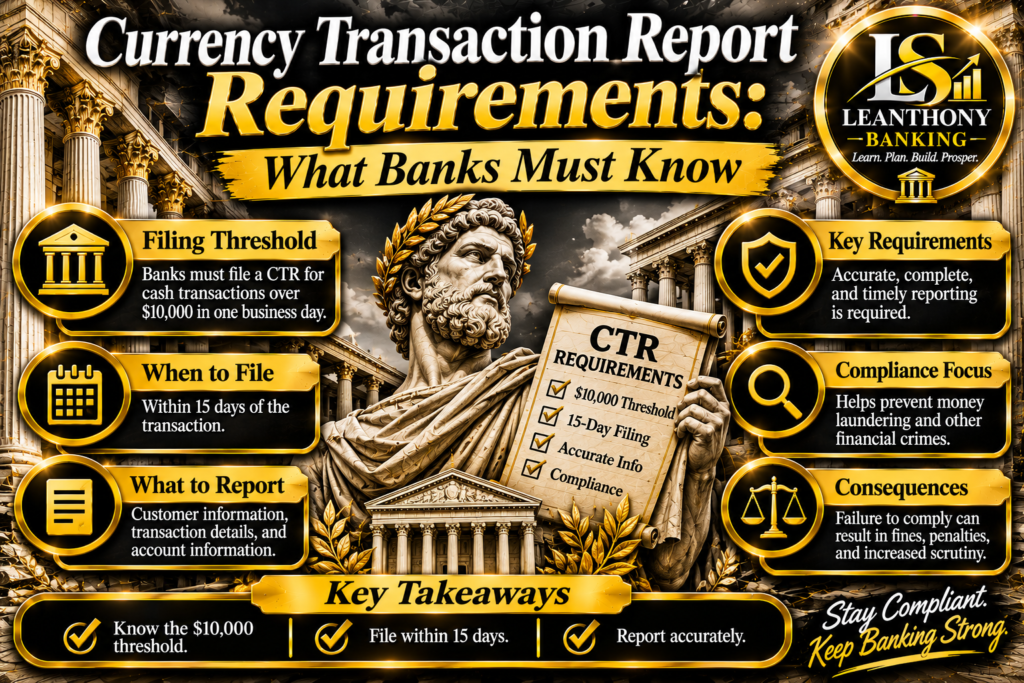
When a client walks into a bank and makes a large cash deposit or withdrawal, there is more happening behind the scenes than they realize.
Banks have specific reporting requirements they must follow, which may include identifying the people involved, reviewing related transactions, and submitting information to the federal government.
Understanding the currency transaction report requirements is useful whether you are curious about how banks actually operate, have a question about a recent cash transaction, or hope to build a career in banking or finance.
As someone who works in banking, I have seen firsthand how important it is to collect accurate information when a report is required; the last thing you want is an email from compliance.
In this article, I’ll explain what banks are expected to do in the event of a CTR transaction.
Quick Answer
Banks generally must file a Currency Transaction Report (CTR) when a qualifying cash transaction involves more than $10,000.
Banks must identify the person conducting the transaction and record information about the person or business that is conducting the transaction. Banks are also required to report transactions when the rules require it, and submit the report to FinCEN within 15 calendar days.
When Must a Bank File a CTR?
Under federal law, banks must report qualifying deposits, withdrawals, exchanges, payments, and transfers involving more than $10,000 in physical currency.
This is the general currency transaction report threshold under 31 CFR § 1010.311.
The word more matters. A single qualifying cash transaction of exactly $10,000 does not meet the general CTR filing threshold. A transaction for $10,000.01 does.
These currency transaction report requirements apply to cash (physical currency) , not simply any transaction involving a large dollar amount. For example, an electronic wire transfer of $20,000 does not automatically require a CTR just because it exceeds $10,000.
Which Transactions Count Toward the Threshold?
The rules cover more than cash deposits. Banks must consider physical currency activity, including:
- Cash deposits into personal or business accounts.
- Cash withdrawals from accounts.
- Exchanges of one type of currency for another.
- Certain cash payments or transfers.
- Qualifying purchases of monetary instruments using cash.
A check, ACH payment, or wire transfer is not automatically treated as a currency transaction for CTR purposes.
Understanding this difference helps explain why a client making a large electronic transfer may be treated differently from someone bringing physical cash into a branch. The amount alone does not determine whether CTR filing requirements apply.
How Do Banks Handle Multiple Cash Transactions?
One of the most important parts of BSA CTR filing requirements is aggregation.
Banks cannot always look at each transaction separately when determining whether a report is required.
When a bank knows that multiple cash transactions were conducted by or on behalf of the same person during a single business day, it generally must combine cash deposits with other cash deposits and withdrawals for that business day.
For example, I remember a situation where a client deposited $8,000 and later made another $2,000 cash deposit. Although the transactions did not happen with me at the same time, the activity triggered BSA and CTR review requirements, and I had to verify information related to the client.
This is a practical example of why banks look beyond the individual transaction taking place in front of one teller. Related activity can matter even when it happens at different times or through different employees.
FinCEN’s guidance also explains that related transactions can involve multiple accounts or branches when the bank has the required knowledge. The rules are not simply based on whether the transactions took place with one employee. FinCEN’s CTR guidance explains how these situations are handled.
What Information Must Banks Collect?
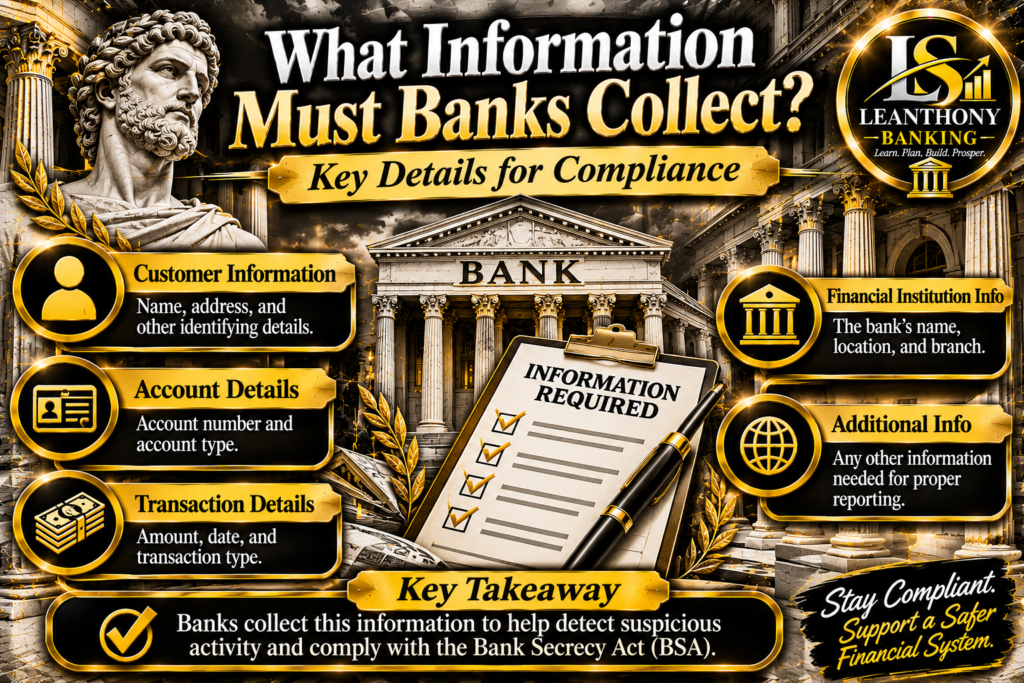
Under 31 CFR § 1010.312, banks must verify and record information about the individual presenting a reportable transaction. They must also record identifying information about the person or business on whose behalf the transaction is being conducted.
Depending on the situation, this includes information such as:
- The name and address of the person conducting the transaction.
- Identification details used to verify that person’s identity.
- The account number, if applicable.
- The name and identifying information of the person or business on whose behalf the transaction is conducted.
- Other information required to complete the report.
In my banking role, I am responsible for confirming information related to the client and documenting details such as where funds came from and what they are for. Just today I had to complete a CTR and again accuracy was of the upmost importance.
These requirements help explain why a teller or banker may ask questions during a large cash transaction. It does not mean the client has done something wrong.
What Are the CTR Filing Deadlines?
Typically banks must complete a currency transaction report filing within 15 calendar days after the reportable transaction occurs.
The report is submitted electronically to the Financial Crimes Enforcement Network (FinCEN), generally through the BSA E-Filing System. Banks must also retain a copy of each filed report for five years from the date of the report.
Can a Bank Exempt a Client From CTR Reporting?
Yes.
Certain clients and businesses may qualify for exemptions under federal rules. However, an exemption is not automatic just because someone regularly deposits large amounts of cash or has maintained an account for years.
Banks must determine whether the business or person meets the applicable eligibility rules and follow the required steps before applying an exemption. Certain businesses are excluded from qualifying, it is then up to the banks have to review the clients or business exemption eligibility.
So all that being said just because a client qualifies for an exemption from CTR filing, that does not mean the bank stops monitoring the account or ignores other reporting responsibilities.
What Happens When a Bank Fails to Follow the Rules?

Banks that fail to meet currency transaction report requirements can face serious consequences.
Depending on the circumstances, violations may result in civil penalties, enforcement actions, or criminal consequences for willful violations.
The consequences are not limited to failing to submit a report. Inaccurate information, repeated late filings, and weak processes for identifying reportable transactions can also create problems for the instituition.
This is why CTR requirements for banks involve more than completing a form.
It is of upmost importance that the banks employees understand the rules, have proper training, review internal checks, and understand the processes that help identify qualifying transactions.
Final Thoughts
Understanding the currency transaction report requirements gives you a better picture of what happens behind the scenes when large cash transactions take place. Banks must identify the people involved, recognize related transactions, meet filing deadlines, and maintain accurate records.
For anyone interested in becoming a banker or working in finance, learning these requirements are a useful starting point. And for clients, knowing what banks are required to do can make questions about large cash transactions easier to understand.
I’m Leanthony Stephens, and through Leanthony.com, I aim to make banking, credit, and consumer finance easier to understand for everyday readers.
Authoritative Sources
- 31 CFR § 1010.311 — Filing obligations for reports of transactions in currency
- 31 CFR § 1010.312 — Identification required
- 31 CFR § 1010.313 — Aggregation
- 31 CFR § 1010.306 — Filing deadlines and record retention
- FinCEN — Frequently Asked Questions Regarding CTRs
- FFIEC — Currency Transaction Reporting Examination Guidance