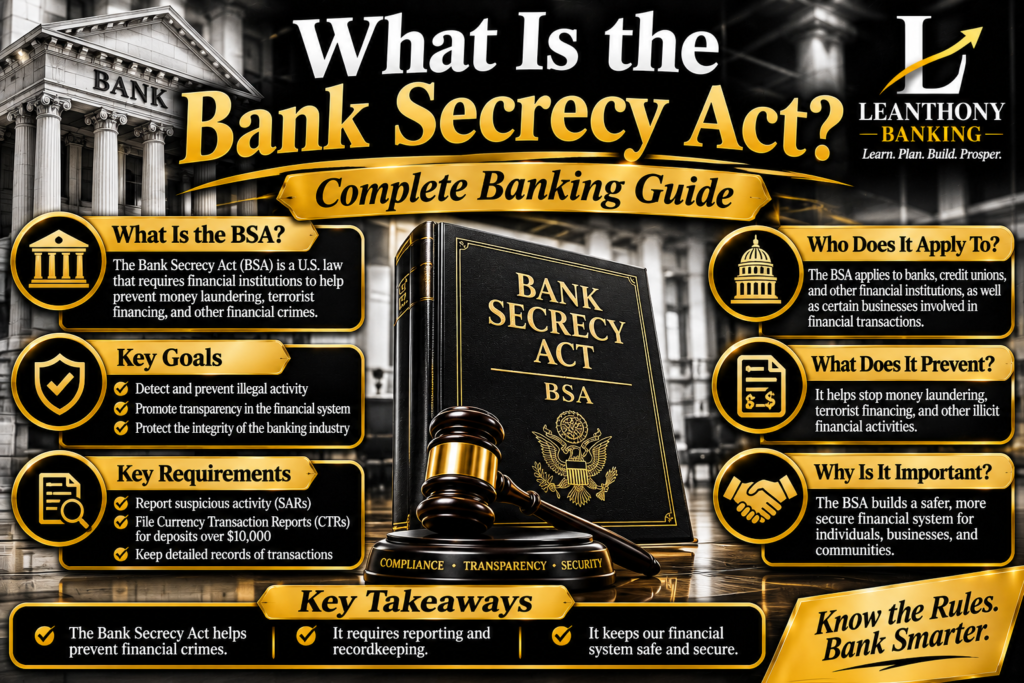
If you have ever heard a banker mention the Bank Secrecy Act, or BSA, you might wonder what the law actually means for your bank account. You may also have heard terms like AML, CTR, SAR, and FinCEN without understanding how they connect.
When I explain the Bank Secrecy Act, I think it helps to start with one important distinction: the BSA is the broader legal framework that establishes certain financial recordkeeping, reporting, and compliance requirements.
In layman terms: BSA is basically the set of rules banks have to follow to keep track of certain financial activity, report suspicious transactions, and help prevent financial crimes like money laundering.
It helps financial institutions identify and report activity that may be connected to money laundering and other financial crimes.
In this guide, I’ll explain what the Bank Secrecy Act is, why it was created, what banks are required to do, and how these requirements can affect everyday banking customers.
Quick Answer: What Is the Bank Secrecy Act?
The Bank Secrecy Act (BSA) is a federal law originally enacted in 1970 to help the government detect and investigate money laundering and other financial crimes. It establishes recordkeeping, reporting, and anti-money laundering responsibilities for covered financial institutions and certain other businesses.
The framework includes requirements involving customer identification, transaction records, Currency Transaction Reports (CTRs), Suspicious Activity Reports (SARs), and financial institution compliance programs.
When Was the Bank Secrecy Act Passed?
The Bank Secrecy Act was enacted on October 26, 1970, through Public Law 91-508. Its formal name is the Currency and Foreign Transactions Reporting Act of 1970.
The original legislation addressed concerns about financial transactions being used to conceal illegal activity. It established requirements for certain financial institutions to maintain records and report particular currency transactions to the U.S. Department of the Treasury.
However, the BSA did not remain limited to its original requirements.
Congress later passed amendments and related laws that expanded the framework, strengthening financial institution responsibilities involving money laundering prevention, customer identification, and suspicious activity reporting.
That is why the term Bank Secrecy Act today refers to more than one reporting requirement. It includes the original law, amendments, and related statutes and regulations.
Why Was the Bank Secrecy Act Created?
The purpose of the Bank Secrecy Act is to help authorities identify, investigate, and prevent financial activity connected to money laundering and other financial crimes.
Consider how money laundering works. Someone involved in illegal activity may attempt to move money through financial accounts, cash transactions, or other financial services to disguise where the funds came from. Without reliable records, following that money can become much more difficult.
The BSA helps address this problem by requiring covered institutions to maintain certain financial records and report specific transactions or suspicious activity when applicable requirements are met.
The goal is not to report every customer or every transaction. The goal is to make certain financial activity traceable and provide useful information to authorities investigating potential financial crimes.
In my year of banking I have not yet seen anything that could be considered money laundering, however I make sure to keep my eyes open and stay alert for any suspicious transactions.
What Does the Bank Secrecy Act Require Banks to Do?
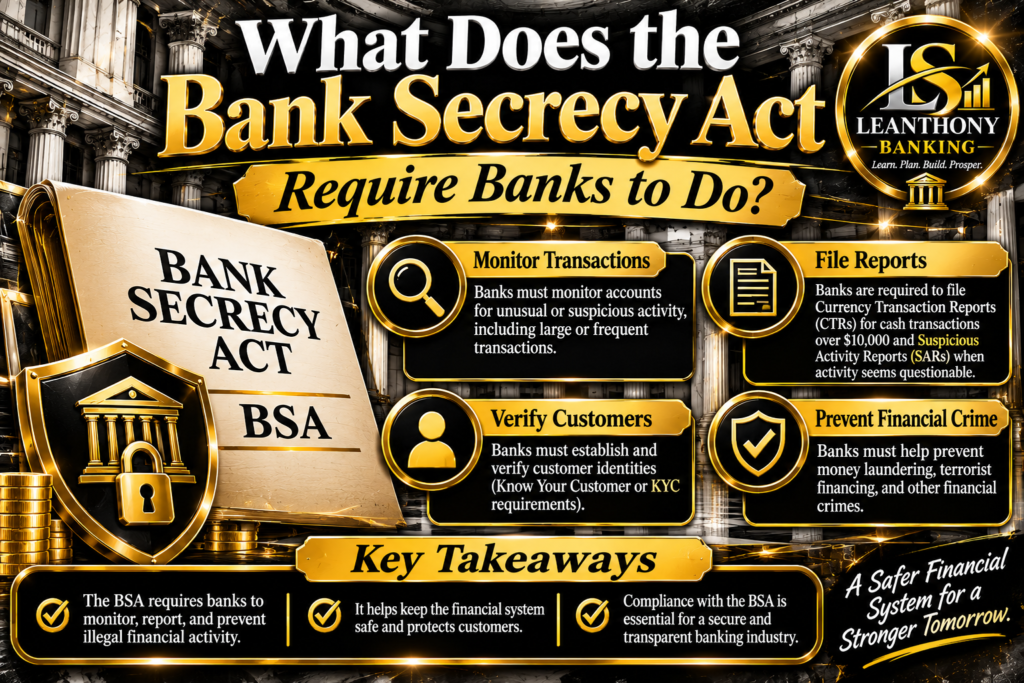
One common misunderstanding is that the Bank Secrecy Act only requires banks to report large cash deposits. In reality, its responsibilities cover several areas of banking operations.
The requirements depend on the type of institution and applicable regulations, but important responsibilities include:
- Recordkeeping: Maintaining required records of certain financial transactions, accounts, and customer information.
- Customer identification: Following applicable procedures to verify customer identities when establishing accounts.
- Customer due diligence: Understanding the nature and purpose of customer relationships and applying risk-based monitoring.
- Transaction monitoring: Reviewing activity to identify patterns that may require additional attention.
- Regulatory reporting: Filing required reports, including CTRs and SARs, when applicable.
- Compliance programs: Maintaining controls, employee training, designated compliance oversight, and independent testing.
For example, when someone opens a bank account, the institution may collect identifying information as part of its customer identification procedures. Later, the bank may review account activity as part of its ongoing compliance responsibilities. I have completed this type of postponed review for my bank.
These requirements work together. Recordkeeping gives institutions information to reference, monitoring helps identify activity that may need review, and reporting provides information to the appropriate authorities when required.
What Is the Difference Between BSA and AML?
BSA and AML are closely connected, but they do not mean exactly the same thing. So let’s explain it.
BSA stands for Bank Secrecy Act. It refers to the federal legal and regulatory framework that establishes certain financial institution obligations.
AML stands for anti-money laundering. It describes the broader policies, procedures, controls, and efforts used to prevent and detect money laundering.
When you see the term BSA/AML in banking, it generally refers to the laws, regulations, and compliance activities that work together to address money laundering and related financial crime risks.
I find it helpful to think of the BSA as part of the legal foundation, while AML describes the broader effort to prevent financial systems from being used to move or conceal illegally obtained money.
How Do CTRs, SARs, and FinCEN Fit Into the BSA?
To understand BSA you will need to first understand these three terms, CTR, SAR, and FinCEN.
Currency Transaction Report (CTR)
A CTR is a report that covered financial institutions generally must file when qualifying currency transactions exceed $10,000 in aggregate during one business day, subject to applicable rules and exceptions.
The reporting rules can include multiple qualifying cash transactions conducted by or on behalf of the same person during that business day when the institution has the required knowledge. Cash deposits and withdrawals are evaluated under the applicable aggregation rules.
A CTR is not an accusation of wrongdoing. It is a required report for qualifying currency activity, and legitimate transactions can trigger the reporting requirement.
Suspicious Activity Report (SAR)
A SAR is different from a CTR. Financial institutions file SARs when they know, suspect, or have reason to suspect activity meets applicable suspicious-activity reporting criteria.
A SAR is not automatically filed because a transaction exceeds a particular cash threshold. The institution evaluates the activity and circumstances under the applicable rules.
Financial Crimes Enforcement Network (FinCEN)
FinCEN is a bureau of the U.S. Department of the Treasury. It administers important parts of the BSA framework, receives financial reports, and analyzes financial information to support efforts against money laundering and other financial crimes.
I explain the relationship this way: the BSA establishes the framework, CTRs and SARs are different reporting tools, and FinCEN plays a central role in receiving and analyzing that information.
Does the Bank Secrecy Act Affect Everyday Customers?

Yes.
Even if you never file or get flagged for a financial report yourself, BSA requirements can affect your banking experience.
For example, everyday as a banker when I open new accounts I must ask for identification when opening a client’s account, request additional information for certain transactions, or review activity as part of my ongoing monitoring responsibilities.
You might also hear about a CTR when completing a qualifying large cash transaction. In that situation, the banker not the customer is generally responsible for filing the required report.
The customer may need to provide identifying information, but the report itself is part of the institution’s regulatory responsibility.
It is important to understand what this does not mean. A CTR does not automatically mean you are suspected of a crime, and a bank’s review of unusual activity does not automatically mean an account must be closed or a SAR must be filed.
Examples: How the Bank Secrecy Act Works in Banking
| Banking situation | Connection to the BSA |
| Opening a checking account | Customer identification procedures may apply. |
| Making qualifying large cash transactions | A CTR may be required under applicable reporting and aggregation rules. |
| Activity that meets suspicious reporting criteria | A SAR may be required. |
| A bank maintaining required transaction records | Supports BSA recordkeeping responsibilities. |
| A bank reviewing customer activity | May be part of risk-based monitoring and customer due diligence. |
These examples represent different compliance responsibilities. They do not mean every customer or transaction automatically triggers a government report.
Final Thoughts
Understanding what the Bank Secrecy Act is makes it easier to understand why banks maintain certain records, verify customer information, monitor activity, and report qualifying financial transactions.
The BSA is the broader framework behind many banking compliance responsibilities. AML programs, customer due diligence, CTRs, SARs, and FinCEN all have different roles within that system.
As Leanthony Stephens, my goal with Leanthony.com is to make banking, credit, and consumer finance easier to understand. Knowing how the Bank Secrecy Act works gives you a better understanding of the rules and processes that help shape the modern banking system.