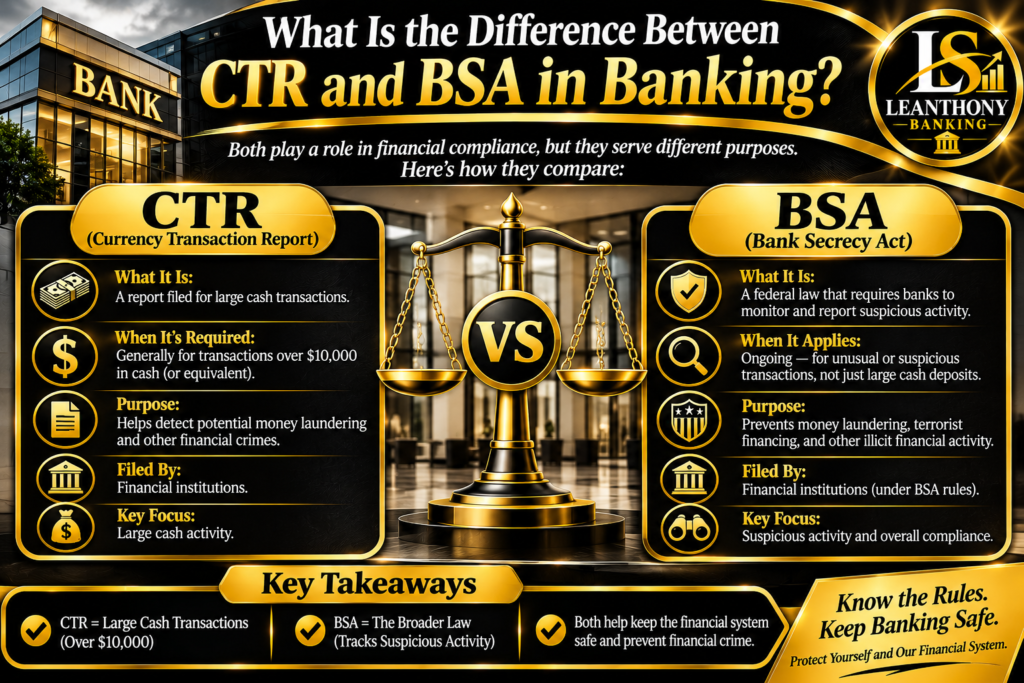
If you’ve ever heard a banker mention a CTR or BSA, you might wonder whether they’re referring to the same thing.
Both terms are connected to banking compliance, cash transactions, and financial crime prevention, but they serve different purposes.
As someone building a career in banking, I think understanding this distinction is important because these terms come up when discussing how financial institutions monitor and report certain activity. The easiest way to understand the difference between CTR and BSA in banking is to remember that the BSA is the broader federal framework, while a CTR is one specific report banks file under it.
LeAnthony Stephens’s Quick Answer
The Bank Secrecy Act (BSA) is a federal legal and regulatory framework that establishes recordkeeping, reporting, and anti-money-laundering responsibilities for covered financial institutions.
A Currency Transaction Report (CTR) is a specific report a financial institution files with the Financial Crimes Enforcement Network (FinCEN) when qualifying currency transactions exceed $10,000.
In other words, the BSA establishes the broader requirements, and the CTR is one reporting tool used to meet them.
What Is the Bank Secrecy Act (BSA)?
The Bank Secrecy Act, originally enacted in 1970, is a federal law commonly associated with anti-money-laundering compliance (AML). Its purpose is to help the government detect and prevent money laundering and other financial crimes by establishing reporting and recordkeeping requirements.
In everyday banking, BSA compliance involves more than reporting large cash deposits. Financial institutions maintain customer identification procedures, monitor transactions, keep required records, train employees, and establish internal controls designed to identify potentially suspicious activity.
FinCEN, an agency within the U.S. Department of the Treasury, administers the BSA framework and receives financial reports from covered institutions.
When I refer to BSA in banking, I’m referring to this broader compliance responsibility, not one individual form.
What Is a Currency Transaction Report (CTR)?
A Currency Transaction Report, commonly known as a CTR, is a report financial institutions file with FinCEN for qualifying transactions involving physical currency of more than $10,000.
For example: if you deposit $12,000 in cash into your checking account, your bank generally has a CTR filing obligation, unless an applicable exemption or other exception applies. The bank uses the information collected during the transaction to complete FinCEN Form 112.
The report generally includes identifying information about the person conducting the transaction, relevant information about the person or entity on whose behalf it is conducted, and details about the currency transaction.
One thing I want to make clear: a CTR is not an accusation of wrongdoing. A legitimate cash transaction can trigger the reporting requirement simply because it meets the applicable threshold.
What Is the Difference Between CTR and BSA in Banking?
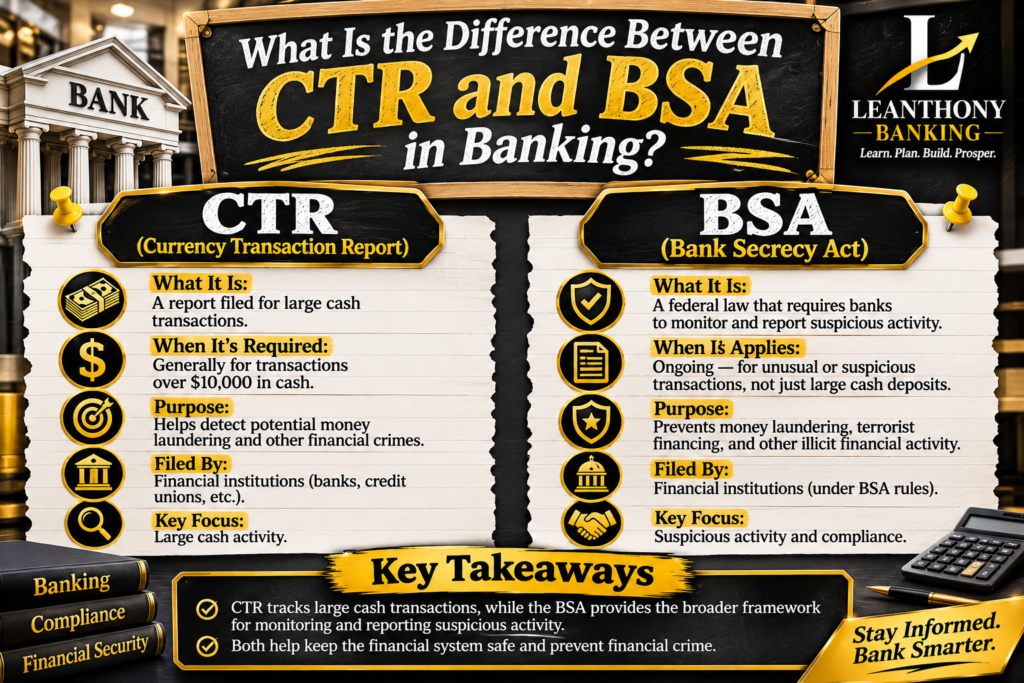
The difference comes down to scope. The BSA establishes a broad set of legal and regulatory responsibilities, while a CTR addresses one specific type of financial reporting.
Think of the BSA as the overall framework that guides a bank’s compliance responsibilities. A CTR is one report within that framework, alongside other requirements such as suspicious activity reporting and recordkeeping.
| Category | BSA | CTR |
| Full name | Bank Secrecy Act | Currency Transaction Report |
| What it is | Federal legal and regulatory framework | Specific financial report |
| Main purpose | Establishes reporting, recordkeeping, and AML responsibilities | Reports qualifying currency transactions |
| Scope | Broad | Specific |
| Government connection | Administered through Treasury and FinCEN | Filed with FinCEN |
| Example | A bank maintains a BSA/AML compliance program | A bank reports a qualifying $12,000 cash deposit |
So, when someone asks me whether CTR and BSA are the same thing, my answer is no. A CTR is part of BSA compliance, but BSA compliance involves much more than filing CTRs.
How Does the $10,000 CTR Reporting Threshold Work?
The CTR threshold generally applies when qualifying physical currency transactions (cash) exceed $10,000. It does not mean every transaction above that amount automatically requires a CTR.
For example: depositing a $15,000 personal check or receiving a $20,000 wire transfer does not trigger a CTR solely because of the transaction amount. The reporting requirement concerns qualifying transactions in physical currency.
Banks also aggregate certain cash transactions conducted by or on behalf of the same person during one business day when they have the required knowledge. This means several smaller cash deposits can collectively exceed the reporting threshold.
What Is the Difference Between a CTR and a SAR?
A CTR and a Suspicious Activity Report (SAR) are both associated with BSA compliance, but they serve different purposes.
A CTR is generally triggered by qualifying currency transactions exceeding $10,000. A SAR, on the other hand, involves activity that a financial institution knows, suspects, or has reason to suspect meets applicable suspicious-activity reporting criteria.
A transaction does not become suspicious simply because it triggers a CTR. Likewise, a transaction below $10,000 can still receive scrutiny and potentially meet SAR reporting requirements. The two reports are not interchangeable.
What Happens When You Deposit More Than $10,000 in Cash?
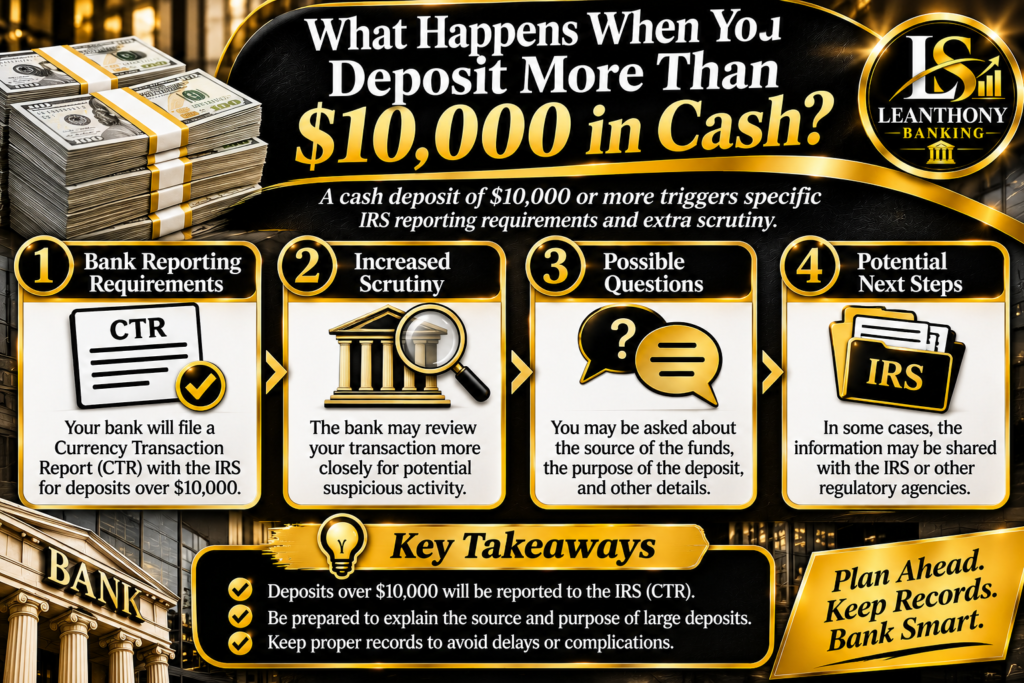
If you make a qualifying cash deposit exceeding $10,000, your bank generally has to collect the required information and file a CTR with FinCEN. You may be asked to provide identification and information needed to complete the transaction record.
You generally do not file the CTR yourself. The financial institution is responsible for submitting the report, typically within 15 calendar days after the reportable transaction.
I also want readers to understand that depositing more than $10,000 in legitimate cash is not necessarily illegal. The reporting requirement does not, by itself, mean you are suspected of money laundering or tax evasion. Just a way for the bank to accurately report back to compliance.
What Is Structuring Under the Bank Secrecy Act?
Structuring occurs when someone deliberately breaks up transactions to evade applicable financial reporting requirements. For example, intentionally dividing a large cash deposit into smaller transactions to prevent a required CTR filing may constitute illegal structuring under federal law.
Under 31 U.S.C. § 5324, structuring, assisting with structuring, or attempting to structure transactions to evade reporting requirements is prohibited. Simply making multiple deposits does not automatically establish structuring; the purpose of evading the reporting requirement matters.
My advice is straightforward: don’t split legitimate cash transactions to avoid reporting. Conduct your banking honestly and provide accurate information when your financial institution requests it.
Examples and Tables
Here are a few examples to make the difference easier to understand:
| Transaction | CTR generally required? |
| $12,000 cash deposit | Yes |
| $15,000 cash withdrawal | Yes |
| $20,000 personal check deposit | Not solely because of the amount |
| $15,000 wire transfer | Not solely because of the amount |
| Three qualifying cash deposits totaling $10,500 in one business day | Generally yes, if aggregation requirements are met |
Remember that cash-in and cash-out totals are evaluated separately. A cash deposit and a cash withdrawal are not simply offset against each other to determine whether the reporting threshold is met.
Frequently Asked Questions
Is a CTR the same as the Bank Secrecy Act?
No. The BSA is the broader federal framework, while a CTR is one specific report filed under its reporting requirements.
Does every deposit over $10,000 require a CTR?
No. The CTR requirement generally applies to qualifying physical-currency transactions exceeding $10,000. A check or wire transfer does not trigger a CTR solely because its value exceeds that amount.
Does filing a CTR mean a bank suspects money laundering?
No. A CTR is generally threshold-based. A legitimate cash transaction can require a CTR even when the bank has no reason to suspect criminal activity.
Who files a Currency Transaction Report?
The financial institution with the applicable reporting obligation files the CTR with FinCEN. Customers generally do not file the report themselves.
Can multiple cash deposits trigger a CTR?
Yes. When a bank has the required knowledge that qualifying transactions were conducted by or on behalf of the same person during one business day, it generally must aggregate them.
Final Thoughts
When you understand the difference between CTR and BSA in banking, the relationship becomes much easier to follow.
The BSA establishes the broader compliance framework, while the CTR is one specific report used to document qualifying cash transactions.
I believe understanding these basic banking terms helps customers make more sense of the questions, procedures, and reporting requirements they may encounter at a financial institution.
I’m Leanthony Stephens, and through Leanthony.com, my goal is to make banking, credit, and consumer finance easier to understand one topic at a time. From me to you have a great day!